• Skip to primary navigation
  • Skip to main content
  • Skip to primary sidebar

CMER

  • CMER
  • Home
  • CMER 2026
    • 2026 Information and Policies
    • 2026 Presenters
    • 2026 Mini-Retreat
    • 2026 Sessions
      • 2026 Standard Plenaries (Fri – Sun)
      • 2026 Standard Break Outs (Fri – Sun)
    • 2026 Schedule
    • 2026 Location
    • 2026 Registration
  • Past Retreats
    • CMER 2016
      • 2016 Speakers
      • 2016 Workshops
      • 2016 Schedule
      • 2016 Location
    • CMER 2017
      • 2017 Speakers
      • 2017 Sessions
      • 2017 Schedule
      • 2017 Location
    • CMER 2018
      • 2018 Speakers
      • 2018 Sessions
        • 2018 Plenaries
        • 2018 Break Outs
      • 2018 Schedule
      • 2018 Location
    • CMER 2019
      • 2019 Speakers
      • 2019 Sessions
        • 2019 Plenaries
        • 2019 Break Outs
      • 2019 Schedule
      • 2019 Location
    • CMER 2020
      • 2020 Speakers
      • 2020 Sessions
        • 2020 Plenaries
        • 2020 Break Outs
      • 2020 Schedule
      • 2020 Location
    • CMER 2022
      • 2022 Speakers
      • 2022 Sessions
        • 2022 Plenaries
        • 2022 Break Outs
      • 2022 Schedule
      • 2022 Location
    • CMER 2023
      • 2023 Presenters
      • 2023 Sessions
        • 2023 Plenaries
        • 2023 Break Outs
      • 2023 Schedule
      • 2023 Location
    • CMER 2024
      • 2024 Presenters
      • 2024 Sessions
        • 2024 Plenaries
        • 2024 Break outs
      • 2024 Schedule
      • 2024 Location
    • CMER 2025
      • 2025 Presenters
      • 2025 Sessions
        • 2025 Plenaries
        • 2025 Break Outs
      • 2025 Schedule
      • 2025 Location
  • Blog
  • Contact
  • About
  • Team Sites
    • Here to Glory (Dawn)
    • A Sacred Education (Jennifer)
    • a humble place (Rebecca)
You are here: Home / Blog

Blog

August 31, 2018 by CMER Team Leave a Comment

CMER 2019: Registration Open

Registration is now open for the 2019 Charlotte Mason Educational Retreat.  Please, visit the CMER 2019 Website to see the speakers, sessions, schedule, and so much more.  We hope you are able to join us.

August 15, 2018 by Karen Canon

King Lear

King Lear - Charlotte Mason Educational Retreat
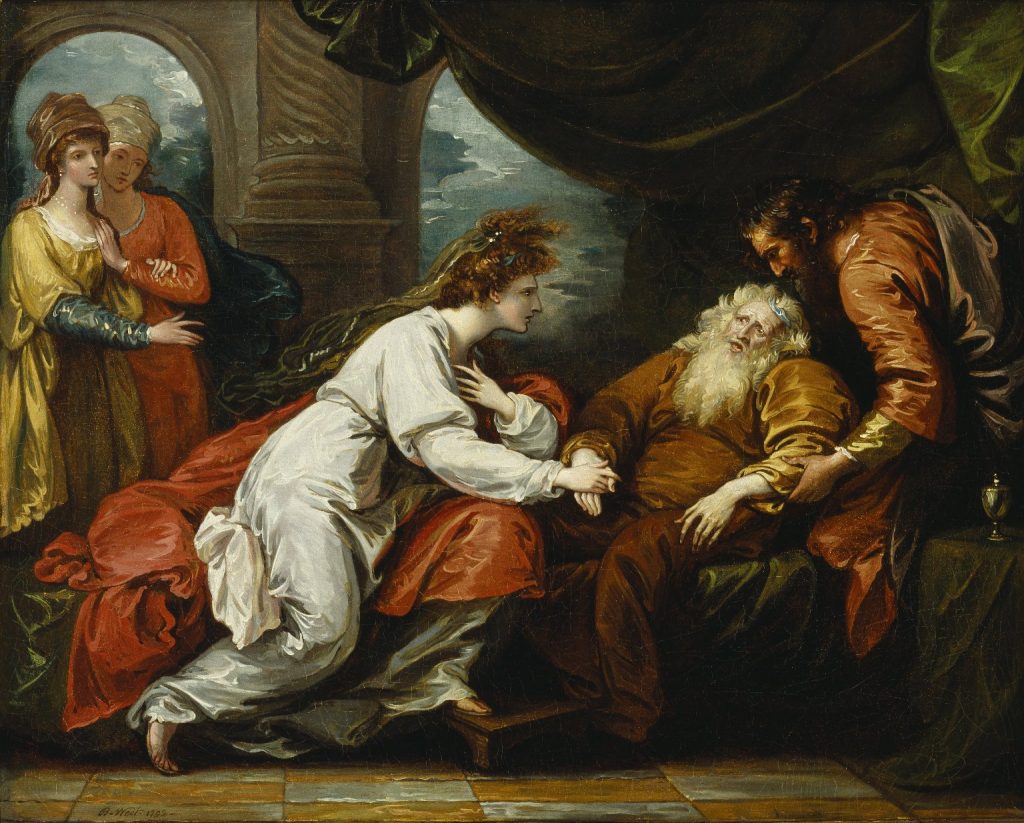
King Lear, Act IV, Scene 7. Benjamin West, 1738.

Anyone else studying Shakespeare’s King Lear this year?

Dorothea Beale wrote an illuminating article on the play in the Parents’ Review. A photograph of the bound volume is available at the Charlotte Mason Digital Collection (Parents’ Review, 1890, p. 642; http://libguides.redeemer.ca/CMDC).

If you’d prefer to print a copy, here is a transcription. Copy and paste into your word processor and enjoy what Beale has to say about the rights and duties of parents and children.

——————–

Lear and His Daughters

by Dorothea Beale

CORDELIA— “I love your Majesty
According to my bond.
KING LEAR— “Better thou hadst not been born,
Than not to have pleased me better.”

How simple at first sight seems the relation of parent and child—dependence on the one side, obedience on the other—yet with increasing years, how full of complications become the problems which require solution, and these can never be worked out unless we get at underlying principles. Is it presumption for one who stands on neutral ground to offer some remarks?
The reciprocal rights and duties of parents and children have furnished the theme of the most stirring tragedies. Had Agamemnon a right to sacrifice the innocent Iphigeneia for what seemed to him the good of his country? Was the resentment of Clytemnestra justified, so that the outraged mother might repudiate the relation of the wise, and avenge her child? Was it the duty of Orestes to be the avenger of blood upon his father’s murderer—upon his own mother? These and such like questions were asked by Greek tragedians. And the greatest tragedian of ancient times brings before us the question in another form, when he shows us the rebel Titan defying the Father of gods and men. Kindred spirits have worshipped at the shrine of Prometheus, but surely the Prometheus Unbound would have shown that the Titan suffered because he erred, because he thought to bless men by breaking the laws of Heaven, because he would not wait until the Lord of the bright sky should see fit to place within man’s reach the give, which only to the law-abiding is a beneficent friend, but to the lawless a devastating fiend,—and so be it was needful that Hephaestos, the beneficent fire spirit, should gorge the chains, and that force should bind the Titan. The two greatest tragedies of modern times, Hamlet and King Lear, turn upon the same subject. In Lear, especially, Shakespeare has shown us lawlessness in many forms, lawlessness with all its terrible consequences. He has dealt chiefly with the parental relationship, but also with the cognate relations of king and subject, of husband and wife, of master and servant, with the ties which bind us to king and to country, the bonds of piety, loyalty, patriotism. He has brought out the underlying principles, and give no uncertain sound. Yet he does not blurt out the reply, for he is no hard dogmatist; ;he is such a consummate teacher, that he compels us to ask our own questions, and draws from our hearts the confession, that only one answer can be given.

It is clear that whenever this subject of parental relationship is discussed, that many are, what Milton would have called “unprincipled.” They cannot give the grounds of the faith that is in them; and some are so on principle; they think that an obedience which depends upon law cannot be an obedience of love. Yet, surely the sense of duty is the support of love, when we are tried by the faults of others, or our own.

Thou who are victory and law
When empty terrors overawe!
From vain temptations dost set free,
And still’st the weary strife of frail humanity.

The want of a clear perception of the true basis of filial duty was recently brought home to many by the tragedy enacted in our midst, when two lads deliberately planned to beat out the brains of their own father in a lonely lane, and on their condemnation for murder, the Home Secretary was besieged by sympathizers, who desired that the culprits should be spared.
There are two kinds of spiritual ties—those of affinity or relationship, and those of personal sympathy. Under the first we include the obligations which bind us together as members of one family, state, nation. We cannot renounce these relations without being “unnatural;” loyalty to the chief, the king, is not dependent only on the character of the ruler; the fact that he stands in a special relation to us, gives him a claim on our allegiance; we feel patriotism, though we deplore the wrongs done by our country, and we all shrink from the traitor who deserts to the enemy. All such relations impose obligations, and rest on what I may call an “eternal,” relation not merely a personal, a transitory one.
There is another form of love, which is both more and less that the first, that which comes from personal sympathy, that which is kindled in us by the vision of goodness. This a parent cannot have by right—it is not obtained by inheritance—it cannot be given at will—it must be won by him who is worthy. Relations sometimes claim this, when they have not cared to deserve it, on the mere ground of relationship.

There is also something which goes by the name of love which is its absolute opposite—is mere selfishness. It is the desire not to give but to receive—the wish to be loved, the greed of love.
Let us consider what is the source of true love, of that feeling which makes us long for, passionately desire the good of another, that which Tennyson has so beautifully described in “Locksley Hall”:–

Love took upon the harp of life, smote all its chords with might,
Smote the chord of self, which trembling, passed in music out of sight,

—that feeling, which makes all thought of self vanish, and quickens us with an energy of desire that another, that all, may be blest; which makes us suffer with those that suffer, and rejoice with those that rejoice. Men have framed theories that it is a “refined selfishness,” either on the part of the individual who loves, or on the part of the community, who force upon him the delusion that what is for their advantage is good for him. But even the theorists of these school shave found their speech too narrow for their thought, and have admitted the old friend under a new name. they have to acknowledge “altruism” as an original principle of human nature. But the new word is not large enough for the old thought, since love includes self too, only not self isolated, but embraced in a larger Self in whom all live, in that larger unity in which the many are truly one; a unity shadowed forth in the order of the starry heavens, which gives to man’s thought an intelligible universe. The conscience and the heart refuse to believe, that for each man his little self if the centre of the moral, the spiritual universe—that there is no central life, no quickening power, in who all live and move. We can account for this “unreasonable,” this passionate desire for the good of all, only by the faith that we are all the children of God, that it is the love of God that we feel in our heart, moving us to love even as He loves. “I said, ye are gods, and ye are all the children of the Highest.” The universal life and love breathing in each, is shadowed forth in the universe, which is its sacrament,—it is the presupposition of all thought; it is the reason of the intellectual world; it is the supreme good of the moral Kosmos, and finds expression in that death to self, that new birth into the Divine the all-embracing, which reveals in man the very life of God.

Now typical parental love, whose supreme joy is the good of the child, is the express image of the Divine. It does not depend on the goodness of the child, but upon the fact of the filial relationship; it will gladly spend and be spent, desiring nothing in return but the development, the perfection of the child; it is as that of the All-Father who is kind even “to the unthankful and the evil, who sendeth rain on the just and on the unjust;” who does good, not for our righteousness but for “His righteousness sake.”

And the reciprocal of this divine love is piety; it is due to Him to whom we owe our being, due to His wisdom and sovereignty, due from the Finite to the Infinite, from the creature of time to the Eternal; and those are foolish and presumptuous who strive to break His laws, who, ignorant and feeble, doubt whether the Judge of all the earth does right.

Resting firmly based on this divine reverence stands the bond which unites parent and child; this the Romans rightly called piety too. They did not call it piety on the part of the parent, but they might, for gravitation is one whether we regard it from the earth’s surface or from the central orb; so the duties of parent and child are reciprocal, and we might even speak of God’s piety towards His own creation.

It is the thought of this all-embracing divine regard which binds us to reverence the life He has given. The All-Wise has committed children to their parents, and from this sacred trust nothing can release them—no sin, no unworthiness. The All-Father hateth nothing that He hath made, but is ever drawing the sinful soul that rejects the bonds of love, by those of discipline. So the parent has never a right to cast off the child, as Lear did Cordelia, nor the child the parent, as his unnatural daughters did their father. Lear taught his daughters impiety towards himself, when he drove out Cordelia. He wanted personal love rather than piety, and chose that which “pleased him better,’ instead of that which was the true, the eternal foundation. He chose that which depended upon his own deserts, which was lost to him, when his daughters could point to the many faults of his old age and weakness, the seeds of which had been planted in prosperity, and which bore such bitter fruits when the sunshine was withdrawn.

Parental love is like the divine love, but exercised under creaturely limitations of submission to the law of God, and limited by the law of man, by social relations. As the joy of the parent is to give, “hoping for nothing in again,” so the joy of the child is to receive. It can give in return nothing but love and gratitude and obedience; it can only seek to fulfill the good wishes of those who love, by becoming such as they would have it. This affection is more than a mere personal claim; the marriage tie is of the same kind, for in such an union the personal relationship is transfigured and made eternal; and the obligations, are of the same kind, which unite us to country, to king, to the institute we serve, the master whose bread we eat, to any whose colours we wear. The terrible consequences of the repudiation of these relations—of lawlessness in its many forms, are made apparent in Lear. The tragedy is like some marvelous fugue in which kindred themes are interwoven, all leading up the final cadence in which they die.

We have in the first scene a few preluding notes, which give the theme, which moves on with marvelous and intricate variations to the very end.

First, Gloucester’s lawlessness, then Lear’s lawlessness; these are the cause of all the misery and crime; out of this grew inevitably the whole evil harvest, because they failed to recognize the unchangeable, divinely-appointed, bonds which none may burst asunder, “chords too intrinse t’unloose.” We may not measure our duty by the deserts of others. In the eternal world, the world of moral laws, ordinances are no less binding that those which rule the material heavens.

The play deals then, not with the subject upon which every novelist of to-day exhausts his ingenuity, the bond of sympathetic personal affection, but with the eternal principles established by divine decree; these form an eternal bond, forged not by the individual, but by the Supreme; and, therefore, the breach of them is Lèse Majesté [treason] against heaven. These instincts, which make the “whole world kin,” are given to the sons of men, not merely as a binding force, but as an apocalypse of God’s own love—to disregard these is to bring upon oneself moral sickness, and even death.

There is also the more personal love, which is kindled in us by the sight of wisdom and goodness. We see the light, and it sets our heart on fire, and because we love the goodness, we love the person in whom we see it enshrined. We are inclined to say it is nobler that the first, but each is perfect of its kind; to God we are bound by the ties both of piety and of love; to persons sometimes by one, sometimes the other.

It is when the two loves are one, when the parent is beloved for his own sake, when the sovereign is the shepherd of his people, when he is worthy of love, to whom we are bound by the ties of piety, of loyalty, that these two currents meet. And it was the double feeling which prompted the joyful cry of the psalmist; “God is the King of all the earth, God sitteth upon His holy seat.”

In the opening words of the play, we are startled by the coarse jest of the libertine, Gloucester: What right has such an one to the sacred name of Father? Can such expect or claim filial love? One who has mocked at the most sacred relations? The miserable father, suffering at the hands of his cruel son, weeps at last for his sin in tears of blood; and is at length redeemed only by the filial piety of Edgar, and brought to confess

The Gods are just, and of our pleasant vices
Make whips to scourge us.

We think at first that Lear is loving, as we see him stripping himself of all and asking only in return tendance, and to be loved; we cannot but feel at first that Cordelia might have been less stiff and hard in speech:–

I love your Majesty
According to my bond; nor more nor less.

Good, my lord,
You have begot me, bed me, loved me; I
Return those duties back, as are right fit:
Obey you, love you, and most, honour you.

* * *
Sure, I shall never marry like my sisters,
To love my father all.

But Lear’s was not true parental love; he did good to them not for their sake, but for his own, and when he got no return he thought he could break the bond, and he taught his two daughters the fatal lesson, that the bond between father and child was not one of eternal obligation, but can be broken at will. But Cordelia felt that as no gifts could purchase, so no offences could destroy it—she alone distinguishes truly between that filial love which was his as her father, and that sympathetic love which she could bestow only on the noble France, the elect of her soul.

And as the play goes on, Shakespeare contrasts this love—loyalty or piety—with personal affection, and shows us that Lear did wrong in craving for that which we may forfeit by our faults, instead of accepting that which will endure whether we are “better or worse; in sickness or in health, till death do us part.”

Lear did not truly love, though he was fond of his daughters, and while all was well, they may have been fond of him, but if he was no more to them than another, they might for his faults cast him out. In Cordelia and Edgar we see the enduring nature of this true filial love. As Cordelia is the guardian angel of Lear, so is Edgar of Gloucester, when poor, blind and miserable, he finds his way to the king.

Then Edgar’s soul is turned to the blessed work of healing the wounded spirit; no injustice that he had suffered could, he felt, release him from the duty to his father; and when the wretched Gloucester would have cast himself from the perilous cliff, he is indeed an angel to bear him up. Other variations of the theme are woven into the scheme of this wonderful drama. There is the faithful loyalty of Kent, persistent to his king through all trials and injustice, serving him faithfully in spite of his faults, because he was his king–

Royal Lear,
Whom I have ever honoured as my king,
Loved as my father, as my master followed,
As my great patron thought of in my prayer.

We have the caricature of this in the evil loyalty, the “honour among thieves,” which binds Oswald, the villain, to her whose servant he was. The tie which binds Albany to his guilty wife forbids him to be the avenger; and patriotism restrains him from joining the foreign army, thought the cause of France was just.
Lastly, we see the evil consequences even in the faithful, the loving Cordelia, of her wrong education; she found evil rampant in her country, and poetry moved her to disregard patriotism. Alone, she would have drawn to her side the noble Albany, the valiant Kent, the true-hearted Edgar, but her error drove the faithful Albany to act with Edmund, and was the cause of her own destruction.

Thus in this great tragedy is a lesson taught with dynamiters, and the lawless of all sorts, may take to heart, that our duties are not measured by the deserts of those to whom we are bound. If Lear was afterwards more “sinned against than sinning,” it was his teaching, his example, which bore one kind of fruit in Goneril’s imperious nature, stiffening her will; another in the weak character of Regan, rendering her passive to evil—we see active cruelty in the one, in the other the still more cruel suggestions of weakness. Who would not rather receive the fierce blows of Goneril, than the stiletto wounds of Regan? She does not originate schemes of wickedness as her sister and Edmund, but she yields to their suggestions, and the evil seed springs up in rank luxuriance.

The parent is to the child in its early years in the place of God; if he do not present to the child the vision of justice and love, then is introduced into his soul moral disorder and confusion—he must lift the eyes of the child, to the perfection which he himself worships, even as the poet has taught us–

I looked on Beatrice, and she on heaven.

We all who have the care of children need to beware of that Lear-like love which demands, instead of seeking to deserve, personal affection. Let us all be thankful that there is a holy bond independent of our faults, which is the salvation of the family and the State; let us desire to win and to add to that hereditary crown which we inherit as teachers, rulers, parents; that crown of personal love by which we are able to bless; which we desire not for self; but for the children’s sake: even as the All-Father bids us love Him—not only because it is our duty to love God, but because He is good, and only in loving Him can we be blest—only in full sympathy with Him can we know the love of God, can we be filled with the fullness of God.

If these great principles were to rule our hearts, if the sacredness and the eternal character of this love were felt, it must show itself in mutual respect and forbearance. The tyrannical voice would not be heard by the little child, though respect and obedience would be required. And there would ever be shown that respect for the child’s conscience, that reverence for the freedom of the will, which comes from our standing consciously side by side in the presence of Him with whom there is no respect of persons—which, may we dare to say it, causes God to permit sin, rather than “crush to earth the children of men,” to break the will, to destroy that which is the glory of our humanity.

If we could always see things in the light of God’s presence, we should not have parents, affectionate as Lear, driving their children from them. We should not have religious parents making religion hateful to their children, because they do not see truth under the same forms; and causing a breach where there was only a temporary misunderstanding “provoking their children to wrath”, saying in act–

Better thou hadst not been born,
Than not to have pleased me better.

Earnest parents sometimes shut away children from the air and sunlight by which alone they can grow up healthy—exact from their children promises which they ought to have left to the conscience of the child.

A parent who recognizes his true relation will feel he has no right to put forth mere arbitrary decrees, like a Saul to Jonathan; he will feel that he must, as far as possible, be the exponent to the child of the will of God; and very early the young child is able to feel (what it may be long ere he will make part of his intellectual consciousness) the difference of the obedience exacted to an external law, to an alien will which is felt as interfering with his freedom, and that obedience which frees him from the bondage to self, and draws him by the cords of love, because the will both of parent and child are embraced in the one will, which makes for righteousness.

Still God’s providential government of the world does confer on the parent a special authority—the fact that the child is, unlike the lower animals, for many years of a long period of immaturity, dependent on the parent, established the responsibility, and, therefore the right of control, and enforces on the child the duty of submission. Later, the years of patient forbearance, of careful education, of parental self-denial, do claim form the child, when no longer dependent, gratitude, respect, obedience, and “loyalty”; the law of filial is written on the “fleshly tablets of the hearts.”

Obedience under normal conditions is not repugnant, but really pleasing to the child, yes, even when his wishes are thereby frustrated, and punishment inflicted. We all naturally desire in times of weakness the support of a righteous will stronger than our own, a will severe and unbending, which “will not spare for our crying.”

In the case of young children especially, it is right to insist on prompt obedience to lawful authority, to demand assent, even without consent, to require an obedience like that of the soldier to his captain; but the object should be, not to substitute our will for that of the child, but to educate the child into the friend, who with advancing years understands us better. The parent’s duty is not to think for the child, except in so far as the child is unable to think for itself, but to appeal to and to educate the conscience, and to enforce obedience to it, when the child, knowing what is right, needs the support of external law to discipline his feeble will. The most fatal error is to crush the will of the child, to try to hinder a mature man or woman from doing what seems right. Resentment is the offspring of tyranny; but reverence is given to the ruler, however severe, who has taught us to be severe to ourselves.

And the far-reaching consequences of a right apprehension of the parental and filial relation in early life is of incalculable importance in helping men to realize the wider relations.

The child that scorned a Father’s care,
How shall he kneel in filial prayer?
How an all-seeing guardian bear?

Clearly the family relation is only a special case of the universal; it is the “form” in which each of us realizes the relation to the All-Father; as every planet in our Kosmos moves in obedience to the central orb, yet exercises its own attractive powers upon the sun and all its kindred stars, so in the “kingdom of Heaven,” neither does the omnipotence of the All-Father exert a power inconsistent with the will of the creature; yet all of us must render obedience to laws which we do not understand; so only shall we find the discipline of sorry not altogether grievous, and be saved from that state of rebellion against the inexplicable, which darkens the lives of many to-day.

On the other hand too, the relation of the soul to “him in whom we live and move and have our being,” embraces all those special relations which bind men together as men; all those relations of mutual benefit and service, of rule and obedience, which come into every relation of life; it is the underlying principle of righteousness or justice; the δικαιοσυνη [fulfillment of the law] of the “Republic” which makes us render to all their due.

Al child is bound to recognize the “divine right” of the parent, and for this reason the parent is bound to rule not arbitrarily, but as one responsible to God for the higher good of the child. It is his privilege to help the child to realize, through loving reverence to the earthly father, that kingdom of heaven in which both are embraced—that law of righteousness, which is perfect freedom. And only when we have so died to self, that we can give up our children absolutely to God’s will, can we truly bless—when we can say to them—not as a mother of old, “Now, therefore, my son, obey my voice,”—but as the nobles of earthly mothers:—“Whatsoever He saith unto you, do it.”

—————————————-
View original article at the Charlotte Mason Digital Collection (http://libguides.redeemer.ca/CMDC) or, https://archive.org/stream/p641-720PRv1n9second/p641-651PRv1n9#page/n0

June 19, 2018 by Karen Canon

On Exams

Charlotte Mason Educational Retreat

I previously shared notes made by a student at Mason’s teacher training college in Ambleside. These were in the form of ‘narrated reports’ completed after a lecture on the ‘History of Education.’

Today I have another set of notes transcribed from Eve Anderson’s (1931-2004) notebooks, this time on the topic of Examinations.

Many of you might be quickly approaching the end of a term and year; may these notes provide perhaps some fresh ideas and encourage you to finish well.


Exams—P.U.S.
Each term a fresh programme is provided so that a standard is set and exams follow the programme, which afford fair chance for all children.

The exams should be carried out without strain, no feeling of worry, rivalry or excitement, and there should be a quiet, serene atmosphere. The children realize that it is an important week. A full week is taken so that there is plenty of time, the exams must be the child’s unaided work. In the home school room they follow the ordinary time-table, but they do exams instead of lessons.

They have exams in every subject. In schools the headmistress draw up a time-table, but not long periods in one subject. The questions are written on the board, the child copies the question onto paper and answers it.

[Forms] 2A upwards should write all work themselves in ink.
2B should write one answer in each subject themselves.
[Upper] 1A should write 2 or 3 answers themselves..
Lower 1A write one answer themselves.
1B Dictate all.

The child should take pride in his exams. Drawing paper should be cut to size, papers should be in the right order. There are 2 mark sheets – one by the examiner which is invaluable to parents, because it gives them an idea whether they are below or above average, and there is the oral sheet, which is the report from the school, all subjects are marked or remarked such as crafts, singing etc. so there is a complete picture of the child, also any exams which have been set privately.

Home school rooms send their exams up always, and schools send one from each form,—a different pupil each time. There are exams every time. The spring ones are corrected at home and the report sent to Ambleside.

Objects of P.U.S. Exams

  1. To focus a terms work for the pupil.
  2. To guide and encourage parents and teachers.
  3. To help and guide those who plan the work.

No revision is necessary.

Standard is reached by children’s work.  Exams show up [a] bad teacher and a bad book.

Constant readjustment is necessary.


Sources:
“Notebooks from Eve Anderson” https://goo.gl/YRvHkp, Box 162, Charlotte Mason Digital Collection, Redeemer University College.

April 17, 2018 by Karen Canon

Snakes in Ireland and Other Thoughts on Composition

Snakes in Ireland and Other Thoughts on Composition - Charlotte Mason Educational Retreat
Original photo by Nheyob – Own work, CC BY-SA 4.0, https://commons.wikimedia.org/w/index.php?curid=39732088. Modified by Karen Canon.

‘Composition’ comes by Nature.––In fact, lessons on ‘composition’ should follow the model of that famous essay on “Snakes in Ireland”––”There are none.”

While researching online for a talk last fall, I had revisited some notebooks belonging to Eve Anderson (1931-2004), a graduate of Mason’s teacher training college. In a box, alongside her Book of Centuries and Nature Note-Books, were notes she had kept from her college days. They kept notes? Yes! It seems they did. Another former student, Joan Fitch, said:–

“We had a lecture, principles of education or history, and then a member of staff giving this would leave the room and we had a quarter of an hour in which to write a report on this lecture. This was, in a sense, the narration method which could be done by children in writing if need be.”

She goes on to say:–

“This was never a criticism, it was a report, an account of, but in our own words, as the children, for instance, were asked to narrate a passage in their words.”

One such report in Ms. Anderson’s notebook is under the heading, ‘Composition.’ It appears within a series of lectures on the ‘History of Education’ and ‘Education in England.’  Appearing alongside a report on Exams under the general heading of ‘P.U.S.’ (Parents’ Union Schools), these two reports provide a point of comparison between traditional approaches and Mason’s method in the P.U.S.

I transcribe her report (below) as it reads in her notebook. These notes are not a polished report by any means; they are a record on paper of her impressions as allowed in the brief time allotted following a lecture.

It may be fitting to keep in mind that Eve Anderson was a student at the House of Education some thirty years after Mason’s death. Changes were afoot, especially after the Second World War. In their diaries, students observed changes at the college; changes with mixed implications. In 1948, one student remarked,–

“We had an innovation this term, a mixed dance for students who were allowed to invite any male friend they wanted.”

Another noted that by 1946 most students went home for their summer half-term break, rather than stay at Ambleside. Mason had deliberately chosen Ambleside for the location of her school, in part to impress a new way of living upon her students and to open up new avenues of pursuits. One could argue that long breaks could impact habits newly formed and paramount to her unique approach.

My purpose in this article isn’t to detail these Post-WWII changes nor to speculate on their impact but they are worth consideration as we read Ms. Anderson’s report on the teaching in her time on composition. More can be read about Mason’s ideas on composition in Home Education and School Education.


Composition

Form I. Children have oral compositions in the narration of tales.

Form II. Have compositions.
IIb. Can start compositions and if they are very slow they may narrate the rest of the composition if they have a lot to say. Choose stories from terms reading, therefore they have some knowledge on subject; they must have plenty of material to work on.  Avoid abstract subjects and those that need generalization and criticism. Do not teach composition; just give the child material to work on. Teach them full-stops and capital letters after but not paragraphs. Avoid the use of slang.

Subjects. Stories from:–

  1. Age of Fable.
  2. History
  3. Geography
  4. Story about a picture they have done.

First attempt at working poetry to be done in metre of poem read.
Can sometimes have imaginary subjects by the end of 2A.

Form III.
Subjects from term’s work, and current affairs.
Write letters.
No special lessons on composition.
They have more subject matter. Subjects should be varied. Write a scene for acting from a term’s book.
Letters of invitation or thanks or descriptive letters.
Subjects for imagination every now and then.
Topics of day
Occasionally own choice. Give them several days to think about it.
Citizenship gives scope. Paragraphs should be insisted on.

Form IV.
Begin to do real teaching.
Children who have read a lot will not need much teaching.
Punctuation and paragraphs.
Lessons on composition about 2 a term. Give concise description.
Compositions on Literature. Essays set on Bacon’s, Pope’s, Lamb’s etc.
There is a book to help teacher.
Tell them 5 processes in writing of essay:–

  1. Think
  2. Make an analysis of thoughts.
  3. Develop analysis into an outline.
  4. Write the essay.
  5. Read it through.

Must give at least 5 minutes to think first.
Give them lesson on different kinds of essays, descriptive, imaginative, concrete subject, topical subject, conversational, abstract.
Get them to suggest subjects.
An oral lesson on opening sentence to essays. Read them good opening sentences.
Criticize a little beginnings offered by one another.
Also consider endings.
Use of reported speech. __replied, shouted, whispered, hinted etc. instead of always ‘said’.
Enlarge vocabulary. Useful for conversation.
Lesson on description – e.g. an old sailor, do it aurally, a good meeting place, an outline of the conversation with sailor.
Pay attention to adjectives.
Building up of an essay—‘blood sports’—introduction on popularity, various kinds. one in particular. controversy on subject, writer’s own thoughts.
These lessons help with arrangement of ideas.

Poetry-4A. Look at metre of poems. Learn rules for metre.

Form V.
Introduction to précis writing, paraphrasing.
Blank verse and sonnet encouraged.


Sources:
Charlotte Mason College by J.P. Inman.
Home Education by Charlotte Mason, p. 243-247
“Notebooks from Eve Anderson” https://goo.gl/FffQKw, Box 162, Charlotte Mason Digital Collection, Redeemer University College.
School Education by Charlotte Mason, p. 178-181.
Transcript of Interview, Joan Fitch, Ambleside Oral History Group.

April 2, 2018 by Dawn Rhymer Leave a Comment

Something Beautiful

My family had gone skiing for the day, leaving me alone. My younger son expressed his concern again and again that I might be sad or I might get bored. I assured him again and again I would be okay.

Something Beautiful - Charlotte Mason Educational Retreat

My day started with goodbye hugs and kisses and a leftover burrito no one wanted. Coffee, devotions, and then I headed out to the barn. I did all the barn chores on my own, something I have not done in years. I did not rush to get through them, but I lingered with the animals. I forgot the beauty of the barn and the beauty of being alone, yet not alone, in the stillness of a gentle morning.

In our pragmatic society, beauty is often set to the side, and what a tragedy to our souls.

This quote is written in my notes from the 2016 Living Education Retreat, where I first “met” Jason Fiedler. He was the closing plenary speaker, and I suppose it was a bit of a one-way meeting. I left thinking, “Wouldn’t it be amazing if he would be able to speak at the Charlotte Mason Educational Retreat?” He and his wife drove away with my name on the list of attendees everyone received in their folders.

Move toward something and not away.

Jason’s plenary was in part responsible for the second CMER. The first CMER made its debut in February, 2016. But the planning team wasn’t sure what the future would hold. The attendance had been small; we didn’t break even; we were not known names in the Charlotte Mason community.

Your idea is worth a risk.

But we had a mission for the CMER: to build Community through a retreat more accessible to those living in the middle of our country; to provide Motivation by coming alongside parents seeking to use a Charlotte Mason education; to inspire self-Education with diverse topics and speakers; and to encourage Reflection through prayer, the Word, and purposeful times of quiet.

We own the failure, and we have very little to do with our success.

Most of the planning team was actually at the 2016 LER. As we drove home, with the providence of Jason’s words fresh on our minds, we made the decision to take the risk of a second CMER.

Others saw the amazing gift Jason has of speaking and connecting with the Charlotte Mason community, and he was invited to be a plenary speaker at the Charlotte Mason Institute Conference in 2017. Meanwhile, at the CMER, we continued to take risks, inviting Nancy Kelly to be our 2018 Plenary speaker and going under contract for the entire Hideaway Inn and Conference Center. We praise God, we had just enough registrations to cover our costs, and, with the support of our families, we committed to a fourth CMER.

There is nothing more important than the soul of your spouse.

It was my husband’s idea to extend an invitation to Jason to serve as our 2019 plenary speaker. My husband has had the privilege of reading through all of Charlotte Mason’s Volumes with Jason over the past two years as part of Art Middlekauff’s Idyll Challenge.

“Why don’t you ask Jason Fiedler?” was my husband’s simple solution.

“You actually know Jason???” Short of knowing my husband met once a month online with men all across the country to discuss the Volumes, I didn’t know much more about his reading group. I still had a very one-sided relationship with the Fiedlers. I sat next to Jason and his wife Amy during a book give-away at the LER in 2017, and Jason whispered an answer to me, allowing me to win all three Ourselves Volumes from Riverbend Press. It didn’t seem quite fair, but he had already won a book and couldn’t win again. Again, my name was on the list of attendees everyone received in their folders.

I just steal great ideas.

We hope you are able to join us at the 2019 CMER to hear the beauty of the words of Jason Fiedler, a father who is intricately part of his family’s journey of a Charlotte Mason Education, as he blesses our community with wisdom, laughter, and tears through his amazing talent as a speaker and story-teller.

What could be in something beautiful?


All quotes in italics are from my notes taken during Jason’s plenary at the 2016 LER.

March 17, 2018 by Dawn Rhymer Leave a Comment

Charlotte Mason Educational Retreat, 2019

We invite you to take part in COMMUNITY, MOTIVATION, self-EDUCATION, and REFLECTION and join us at the Charlotte Mason Educational Retreat, 2019.

WHO?

The CMER Team and the Aspen Grove Educational Community
with
Jason Fiedler

We are excited to announce the 2019 CMER Plenary speaker. We are thrilled Jason and his wife Amy have accepted our invitation to join us.  Jason has been a speaker at both the Living Education Retreat and the Charlotte Mason Institute Summer Conference.  Amy will be joining him for the opening plenary and will also be hosting break-out sessions.

Jason FiedlerJason Fiedler has always been a storyteller.  As a distracted child, struggling to find his place in a school system not conducive for a boy with undiagnosed learning disabilities, “storyteller” was rarely used as a positive label.  But now, as founding pastor of Water City Church in Oshkosh, Wisconsin, life revolves around telling the God Narrative – and helping others discover their place in it.  His wife of nineteen years, Amy, has been his patient tour guide on this Charlotte Mason journey that began in 2012.  It is his joy to be called “daddy” by their four children (ages 4 – 12).


WHEN?

Friday, February 8, 2019, to Sunday, February 10, 2019

WHERE?

Colorado Spring, CO
The Hideaway

The Hideaway - Charlotte Mason Educational Retreat
Photo courtesy of The Hideaway

INFORMATION

Registration for CMER 2019 will open in August.  At that time, cost, a schedule, session descriptions, and policies will also be available.

  • « Go to Previous Page
  • Page 1
  • Interim pages omitted …
  • Page 14
  • Page 15
  • Page 16

Primary Sidebar

Charlotte Mason Educational Retreat

At the CME Retreat Blog, we hope to share with you more information about a Charlotte Mason Education, the retreat, the speakers, the workshops and so much more!

Subscribe

Enter your email address below to receive new updates by email!

Join us on Facebook

  • Facebook

Categories

  • Art
  • Clay Modeling
  • CMER 2024
  • CMER 2025
  • CMER 2026
  • CMER News
  • Composer
  • Composition
  • Exams
  • Favorite Homeschool Resources
  • Folksong
  • Foreign Language
  • Geography
  • High School
  • Hymn
  • Miscellaneous
  • Narration
  • Planning for the New School Year
  • Plutarch
  • Poetry
  • Scheduling
  • Shakespeare

Search

Authors

  • CMER Team
  • Dawn Rhymer
  • Jennifer Taylor
  • Karen Canon
  • Niko Lewis

Archives

  • January 2026
  • December 2025
  • October 2025
  • September 2025
  • May 2025
  • January 2025
  • December 2024
  • October 2024
  • March 2024
  • February 2024
  • January 2024
  • November 2023
  • September 2023
  • July 2023
  • February 2023
  • November 2022
  • October 2022
  • June 2022
  • February 2022
  • January 2022
  • December 2021
  • November 2021
  • October 2021
  • December 2020
  • November 2020
  • May 2020
  • April 2020
  • February 2020
  • January 2020
  • December 2019
  • November 2019
  • October 2019
  • September 2019
  • August 2019
  • March 2019
  • December 2018
  • October 2018
  • September 2018
  • August 2018
  • June 2018
  • April 2018
  • March 2018

Copyright © 2018-2026 · Charlotte Mason Educational Retreat
Physical Address: 1500 N GRANT ST STE C, Denver, CO 80203, US
Mailing Address: PO Box 56, Brooks, GA 30205, US
EIN 30-1 379655
[email protected]