It brings joy to see where we gather from each year.
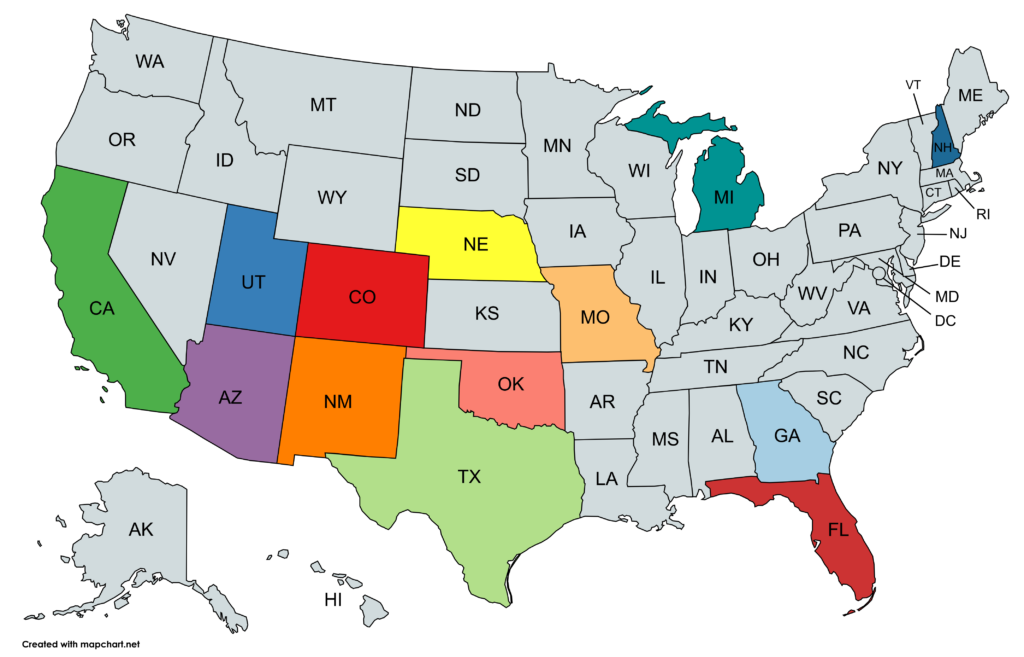
It brings joy to see where we gather from each year.
I wonder if there isn’t a lot of bunkum in higher education? I never found that people who were learned in logarithms and other kinds of poetry were any quicker in washing dishes or darning socks. I’ve done a good deal of reading when I could, and I don’t want to “admit impediments” to the love of books, but I’ve also seen lots of good, practical folk spoiled by too much fine print. Reading sonnets always gives me hiccups, too.
I never expected to be an author! But I do think there are some amusing things about the story of Andrew and myself and how books broke up our placid life. When John Gutenberg, whose real name (so the Professor says) was John Gooseflesh, borrowed that money to set up his printing press he launched a lot of troubles on the world.
Andrew and I were wonderfully happy on the farm until he became an author. If I could have foreseen all the bother his writings were to cause us, I would certainly have burnt the first manuscript in the kitchen stove.Miss Helen McGill
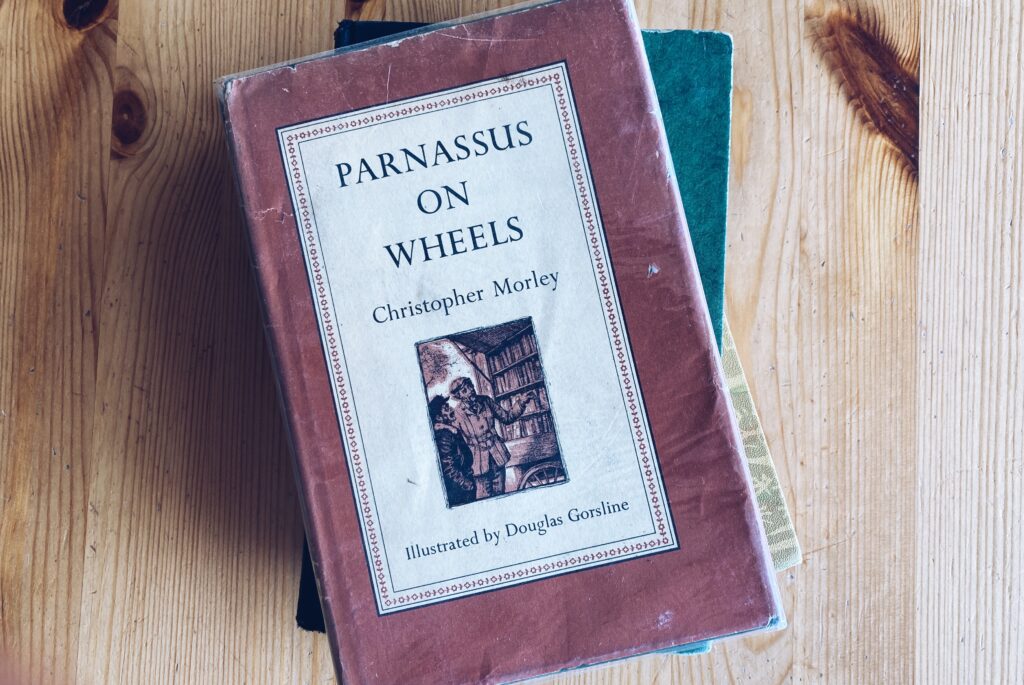
Parnassus on Wheels
Thus begins Parnassus on Wheels, our selection for the 2026 CMER Book Discussion. We hope you can join us. If you haven’t started yet, don’t worry—this is a short, delightful book, and there is still time to read it before the retreat.
Parnassus on Wheels is available free on Project Gutenberg, Internet Archive, or for purchase on Amazon. Being in the public domain, there are many versions of this book. We have reviewed the one we linked to on Amazon (ISBN 978-0486817309) and found it to be a decent choice.
And since you know you cannot see yourself
So well as by reflection, I, your glass,
Will modestly discover to yourself
That of yourself which you yet know not of.-Cassius, Act I, Scene 2
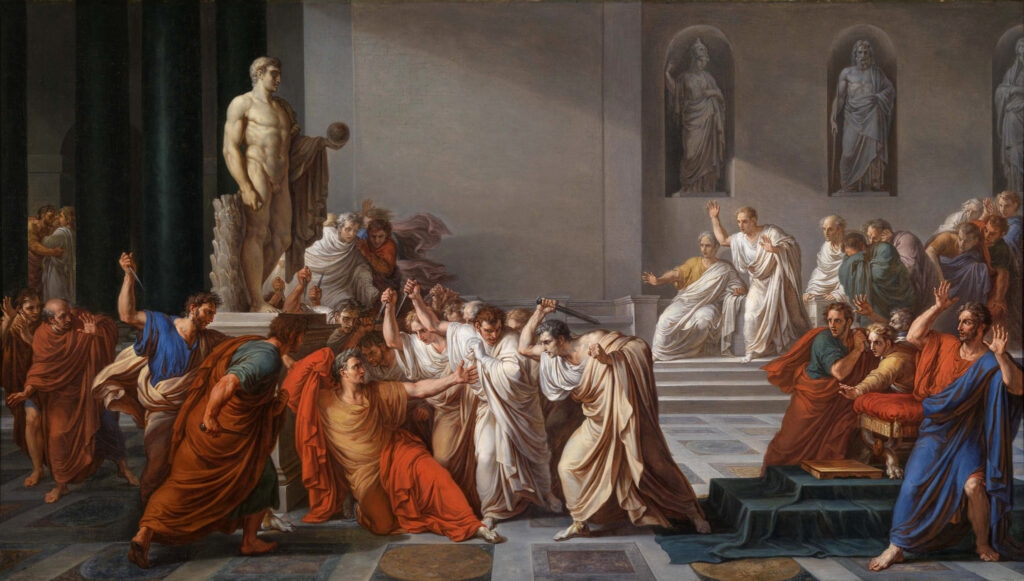
Julius Caesar is one of the Shakespearean plays that is regularly found on Charlotte Mason’s programs of study for her students. And we are delighted to announce that it will be our selection for the 2026 CMER.
One of our evening activities is a group reading of the play. No experience is needed. We will assign parts by scene and do a 30-minute version of the play. If you are not familiar with the 30-minute Shakespeare, Nick Newlin has done a tremendous job abridging the plays “while keeping the beauty of Shakespeare’s language intact.”
Every time the play Julius Caesar is scheduled, the life in Plutarch is read during the same term.
-Nancy Kelly
It is great fun! And we may tie in some Plutarch readings to add to the fun. We hope see you there!
This year, my daughter and I are reading Plutarch with a group of 15 students, aged 10 to 17. It is a mixed bag in terms of experience with Plutarch ; for some, this is their first exposure to Plutarch. Here is how we handled the first term’s Plutarch exam.
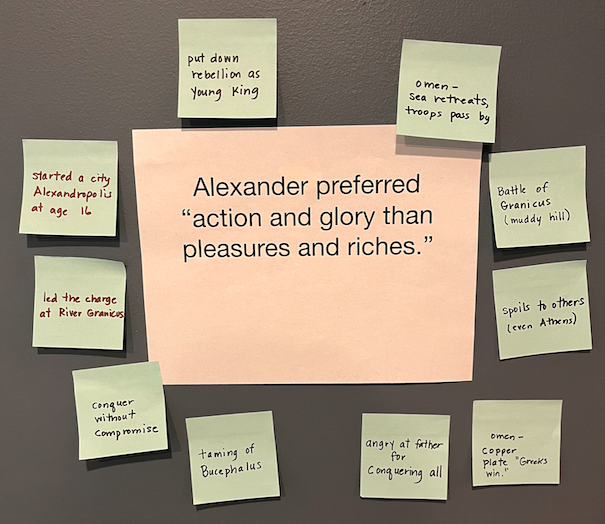
We are reading the Life of Alexander for the entire year, using Edwin Ginn’s text, which is abridged and annotated for schools using Clough’s translation. This term, we decided on an in-class group activity for the exam. It went like this. The week before the exam, each student wrote a list of stories they recalled from our readings thus far. Short answers like “Bucephalus” or “Homer’s Iliad” were acceptable. Then, as a group, they compared and compiled their lists into a single list.
For the day of the exam, I had re-written the anecdotes from their compiled list onto sticky notes and stuck them up on a wall. Working in small groups, their task was to choose the anecdotes that best matched a given character trait and demonstrated how Plutarch supported that idea. For example, one group had the statement that Alexander preferred “action and glory than pleasures and riches.” To support that claim, they chose stories from his life such as his founding a city at age 16 and his displeasure at his father’s conquering “all” and leaving little scope for Alexander.
The other groups had these statements: Alexander often acted with “resolution and magnanimity” rather than giving in to the masses, and Alexander was “a great lover of all kinds of learning and reading.”
Sometimes they challenged one another, “Why did you include this story?” and sometimes they had to decide if a story was a better example of one trait or another. It was a lively time, filled with great discussions and observations.
Give it a try and let me know what you think!

During an immersion, we delve into several subjects that appear on lesson plans for elementary students, experiencing them from the student’s point of view. We read, listen, look, and narrate.
Something happens when you see Mason’s approach to lessons from this vantage point. You can see the principles at play in the lessons, and you empathize with your students. Attending and narrating is demanding; even more so when you’ve had little sleep or are in a room of strangers. These are situations that our students face, and taking in the view from their vantage point helps us see how we can better model, support, and encourage them.
If your kids are younger, this is a great time to catch a vision for what lies ahead.
And, if your kids are older, there is still value for you. Narration is narration is narration. Older kids are dealing with knowledge that may be more abstract, detailed, or complicated, but the need to attend to and reflect on the material until it becomes one’s own remains the same.
If you’ve never experienced a CM lesson as a student, we invite you to join us in February and take the plunge! The Mini-Retreat option includes a full morning of immersion lessons and a talk on Mason’s twenty principles with ’26 plenary speaker, Art Middlekauff.

I look forward to presenting Transcripts for a Charlotte Mason Educator. I had the opportunity to share this workshop at The Weekend of Living Ideas this past fall, and between the questions I received there and those that continue to come in by email, it is clear that Charlotte Mason families have a great need for support during the high school years.
Even though some of us will have an extra day together and there will be opportunities for consultations with Art Middlekauff and Jennifer Taylor, our time at the CMER will still feel short. With that in mind, I want to recommend a resource accessible to both local and nonlocal families.
The Christian Home Educators of Colorado offers an excellent seminar, High School and Beyond. I had the privilege of attending this seminar when my own family was on the verge of entering high school, and it was invaluable. It is available in person (Castle Rock, January 10th) as well as through on-demand recordings.
Several team members and speakers have walked the road to high school graduation and beyond. Collectively, we have experience with students who have pursued college, the military, and gap years. Many of the families attending the retreat bring their own rich experiences as well. For those seeking encouragement, we are eager for the many high school discussions that will take place throughout the retreat.
We hope to see you there!